Inside Zhongshan Hospital's Cardiac Center — Where 8,000 Heart Surgeries Happen Every Year
We visited one of China's busiest cardiac surgery centers. Here's what we saw — the technology, the team, and why international patients are choosing it.
The elevator doors open on the fifth floor of Zhongshan Hospital's Building 16 and the first thing you notice isn't the equipment — it's the pace. Nurses in teal scrubs move between monitoring stations with a quiet efficiency that feels rehearsed but isn't. A row of screens along the central corridor displays real-time vitals from 40 post-operative beds. Somewhere behind the double doors to the left, a surgical team is halfway through a mitral valve repair. It's 9:15 in the morning, and this is already the third case of the day.
Zhongshan Hospital, affiliated with Fudan University in Shanghai, performs more than 8,000 cardiac surgeries annually. That number places it among the highest-volume heart surgery centers in the world — not just in China, but globally. For context, the Cleveland Clinic performs roughly 5,000-6,000 cardiac operations per year. Volume isn't everything in surgery, but in cardiac care, the evidence is unambiguous: hospitals that do more heart surgeries have lower mortality rates. It's one of the most well-documented relationships in all of surgical medicine.
Walking Through the Cardiac Outpatient Department
Our visit starts where every patient's journey starts — the cardiac outpatient clinic on the second floor. It's a sprawling operation. On a typical weekday, the cardiology department sees 500-700 outpatients. The hallway is lined with numbered consultation rooms, each staffed by a cardiologist who'll review imaging, run an ECG, and determine whether a patient needs medical management or surgical intervention.
For international patients, the process is different. SinomedTrip arranges appointments in the hospital's International Medical Center, a separate wing with English-speaking coordinators. Wait times here are measured in days, not weeks. Dr. Liu Hao, an attending cardiac surgeon who has treated patients from Malaysia, Russia, and the United Arab Emirates, put it simply: "We see the international patient within 48 hours of arrival. Pre-operative workup — echocardiogram, CT angiography, bloodwork — is completed within 24 hours after that. If the patient needs surgery, we operate within the week."
That pace would be remarkable at most Western hospitals, where the gap between referral and surgery can stretch to months. Here, it's routine.
The Catheterization Lab
One floor up, the catheterization labs tell the story of where cardiac care has moved in the last decade. Zhongshan has eight cath labs running simultaneously. Two of them are hybrid operating rooms — rooms equipped for both catheter-based interventions and open-heart surgery. If a stenting procedure encounters a complication that requires emergency conversion to open surgery, the patient doesn't need to be transferred. The room converts in minutes.
The hybrid ORs are built around Siemens Artis pheno angiography systems with ceiling-mounted robotic C-arms that give surgeons real-time 3D imaging during procedures. It's the same technology you'd find at the Mayo Clinic or the German Heart Center in Munich. In the second hybrid room, a team is performing a transcatheter aortic valve replacement — TAVR — on a 78-year-old patient who was too frail for open-heart surgery. The valve, delivered through a catheter threaded up from the femoral artery, will be deployed and functional within the hour.
Zhongshan's TAVR program has performed over 2,000 cases since inception. Their 30-day mortality rate for TAVR sits below 2%, which matches or beats published benchmarks from major European and American registries.
The Operating Theater
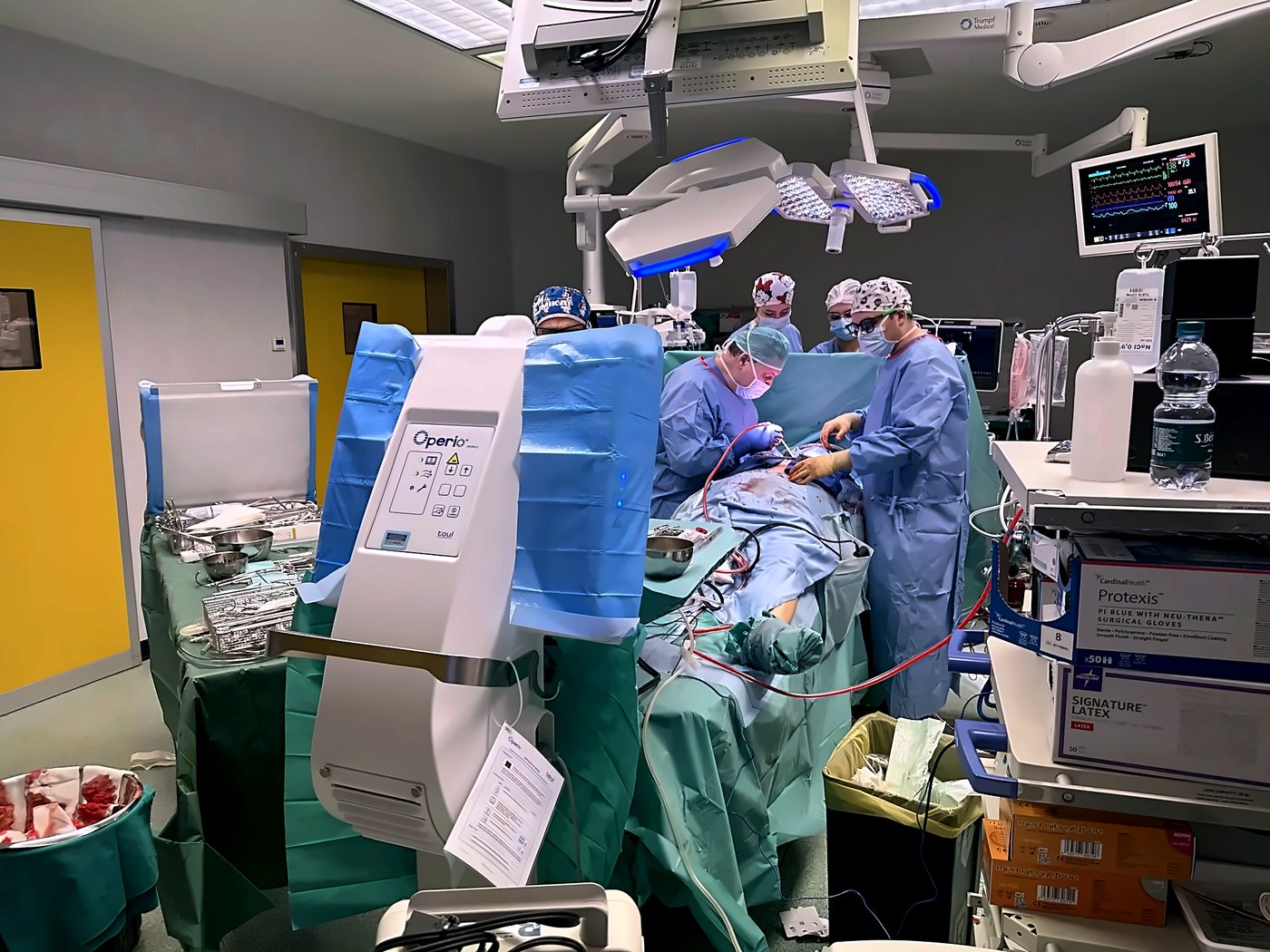
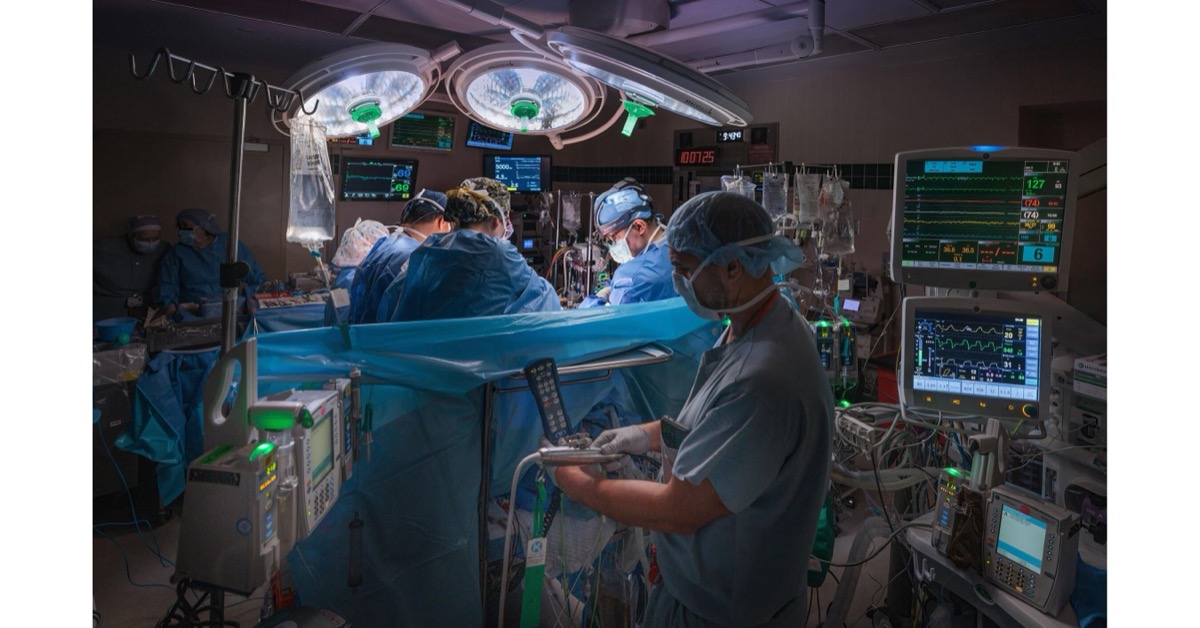
The cardiac surgical suite occupies most of the sixth floor. There are 12 operating rooms dedicated to cardiac surgery, and on a busy day, 10 of them are running cases. A whiteboard near the coordinator's desk lists today's schedule: four coronary artery bypass grafts (CABG), two mitral valve repairs, one aortic root replacement, one redo sternotomy, and two minimally invasive procedures.
The minimally invasive cases are done with the da Vinci Xi robotic surgical system. Through three small incisions between the ribs, the surgeon controls articulated instruments while viewing a magnified 3D image of the heart. The Xi system's wristed instruments can rotate 540 degrees — far beyond the range of a human hand — making it possible to suture in spaces that would be extremely difficult to reach through traditional open surgery. Zhongshan was among the first hospitals in China to adopt robotic cardiac surgery and has performed more than 800 robotic-assisted heart procedures.
I watched the tail end of a mitral valve repair through the observation gallery. The surgeon, working from the robotic console six feet from the patient, placed annuloplasty ring sutures with a speed that comes from repetition. The entire procedure, from first incision to chest closure, took three hours. The patient would be extubated within hours and walking the next morning.
The ICU
The cardiac ICU is a 60-bed unit with a 1:2 nurse-to-patient ratio. Every bed has continuous arterial line monitoring, central venous pressure monitoring, and a dedicated ventilator on standby. The unit is divided into sections: post-CABG, post-valve, post-TAVR, and a high-acuity section for patients requiring mechanical circulatory support — ventricular assist devices or ECMO.
What stands out here is the handoff protocol. When a patient arrives from the operating room, the surgical team, anesthesia team, and ICU team do a structured handover that takes 10-15 minutes. Every medication, every hemodynamic parameter, every concern is verbalized and documented. It's the kind of protocol you'd see at top-tier academic medical centers anywhere in the world, and it exists here because this team handles the volume of a small town's worth of heart surgery every year.
The Recovery Ward
By day two or three after surgery, patients move from the ICU to the step-down ward. The rooms here are quieter. Patients are sitting up, eating, beginning supervised walking. For international patients, the recovery rooms are in the VIP ward — private rooms with an attached bathroom, a sofa bed for a companion, and Wi-Fi. A bilingual nurse coordinator checks in twice daily.
Dr. Liu mentioned that most international CABG patients are discharged 5-7 days after surgery. "We want them comfortable enough to fly within two weeks," he said. "But we also want to see the sternal wound healing well and the echocardiogram looking stable before we clear anyone for a long-haul flight."
For patients who want to understand what the full journey looks like — from the initial inquiry through surgery and follow-up — there's a step-by-step walkthrough on the how it works page.
The Numbers That Matter
Zhongshan's cardiac surgery department publishes its outcomes. The data isn't hidden behind paywalls or marketing language. Here are the key figures:
- Annual cardiac surgery volume: 8,000+ cases
- CABG in-hospital mortality: 0.8% (national average in the US: 1.5-2%)
- Valve surgery in-hospital mortality: 1.2%
- TAVR 30-day mortality: <2%
- Average ICU stay (CABG): 1.5 days
- Average hospital stay (CABG): 6-8 days
- Robotic-assisted cardiac procedures: 800+ cumulative
Cost Comparison
For international patients, the financial difference is substantial. Below are approximate all-inclusive costs (surgery, anesthesia, ICU, hospital stay, medications) at Zhongshan compared to typical US pricing.
| Procedure | Zhongshan Hospital (USD) | United States (USD) |
|---|---|---|
| Coronary artery bypass graft (CABG) | $18,000 – $25,000 | $70,000 – $150,000 |
| Mitral valve repair | $15,000 – $22,000 | $50,000 – $100,000 |
| Aortic valve replacement (surgical) | $16,000 – $24,000 | $60,000 – $120,000 |
| TAVR (transcatheter aortic valve) | $25,000 – $35,000 | $80,000 – $170,000 |
| Robotic-assisted mitral repair | $20,000 – $28,000 | $70,000 – $130,000 |
These are estimates. Individual costs vary based on complexity, implant selection, and length of stay. For a personalized cost estimate, you can request a consultation with the procedure details and your medical records.
Why Patients Come Here
There's no single reason. For some, it's the cost — a patient from the US facing a $120,000 bypass surgery bill without adequate insurance can get the same operation for a fifth of the price. For others, it's the wait time — patients from countries with public health systems sometimes face 6-12 month queues for non-emergency cardiac surgery. Here, they're on the table within a week.
But there's a third category that Dr. Liu mentioned — and it surprised me. "We see patients who've been told they're inoperable," he said. "They come with complex anatomy, multiple prior surgeries, or conditions that smaller centers don't have the volume to handle confidently. We've done enough of these cases to say yes when others say no."
That confidence comes from volume. When your team performs 8,000 cardiac surgeries a year, the rare case isn't rare anymore. It's Tuesday.
For a full list of cardiac procedures available through our partner hospitals, visit the treatments page.
Zhongshan Hospital is one of several cardiac surgery centers in SinomedTrip's hospital network. If you're considering heart surgery in China, our team can help match you with the right center based on your diagnosis, procedure needs, and location preference.
This article is for informational purposes only and does not constitute medical advice. Always consult a qualified healthcare provider for diagnosis and treatment decisions.