LASIK in China vs Korea vs Japan: An Honest 2026 Comparison
LASIK, SMILE and ICL compared across China, South Korea and Japan — prices, technology, surgeon volume, aftercare and logistics, including each country's weak spots.
LASIK in China vs Korea vs Japan: An Honest 2026 Comparison
If you're planning laser eye surgery in East Asia, you'll quickly find three countries competing for your attention: China, South Korea and Japan. All three have excellent surgeons. All three use the same German and American lasers. And every clinic website will tell you it's the best.
The truth is more nuanced. Each country has real strengths and real weak spots, and the right choice depends on your prescription, your budget and how much hand-holding you want. Since we coordinate eye surgery in China, we'll be explicit about where China is not the best option.
Head-to-Head Overview
| Factor | China | South Korea | Japan |
|---|---|---|---|
| SMILE (both eyes) | $2,000 – $3,200 | $1,900 – $3,000 | $2,300 – $3,600 |
| Femto-LASIK (both eyes) | $1,500 – $2,600 | $1,400 – $2,400 | $1,800 – $3,000 |
| ICL lens implant (both eyes) | $4,500 – $6,500 | $4,200 – $6,200 | $5,000 – $7,800 |
| Surgeon volume | Very high | Very high | Moderate |
| English support | Good at top hospitals, inconsistent elsewhere | Excellent in Seoul | Limited outside Tokyo |
| Typical stay needed | 5–7 days | 4–6 days | 5–7 days |
| Hospital vs clinic model | Mostly hospital departments | Mostly private clinics | Mix, mostly clinics |
| Entry for US/EU travelers | Visa-free or 240-hour transit for many | K-ETA, simple | Visa-free for most |
For comparison, the same procedures in the US typically cost $4,000–$6,000 for SMILE and $8,000–$10,000 for ICL. All three Asian options save roughly half.
Cost: Closer Than You'd Expect
Many patients assume China will be dramatically cheaper. For laser vision correction, it isn't. China and Korea are within a few hundred dollars of each other, and Japan is about 10–20% higher.
The difference shows up in what's included. Chinese hospital packages usually bundle the full pre-op workup (corneal topography, OCT, pachymetry, dilated exam) and several follow-ups. Some Korean clinics advertise a low headline price and charge extra for "premium" lasers, eye drops or follow-ups. Always ask for an itemized quote.
If price is your only criterion, choose whichever country is cheapest to fly to. Our pricing page lists current packages in China.
Technology: Effectively Identical
All three countries use the same platforms: ZEISS VisuMax for SMILE, Alcon WaveLight and ZEISS MEL 90 excimer lasers for LASIK, and STAAR EVO ICL lenses. Newer versions, such as the VisuMax 800 and SMILE pro, are available at leading centers in all three countries.
China's distinctive advantage is scale. It has become the largest SMILE market in the world, and top surgeons at major hospitals in Beijing, Shanghai and Xi'an have performed tens of thousands of procedures each. Korea is a close second for surgeon experience. Japan's surgeons are highly skilled but perform fewer refractive procedures per capita, partly because the market is more conservative.
Quality and Safety
Here, honest nuance matters.
China: Leading public hospitals — such as Peking Union Medical College Hospital, which runs a high-volume program for students after their college exams — follow strict national standards. The risk lies in small private "eye centers" with aggressive pricing and less experienced surgeons. Stick to accredited hospital departments.
Korea: Seoul's top refractive clinics are excellent and very efficient. The downside is a highly commercial market. Some clinics run high-throughput "conveyor belt" schedules, and the surgeon who consults you may not be the one who operates. Ask directly.
Japan: Safety culture is outstanding, and screening tends to be conservative — Japanese surgeons are quicker to say "you're not a good candidate." The industry's reputation was dented by a widely reported 2009 infection outbreak at a Tokyo clinic, which led to much stricter oversight. Today, Japan is arguably the most cautious of the three.
Candidacy and Advanced Cases
For straightforward myopia (−1.00 to −8.00) with healthy corneas, all three countries deliver excellent results.
For complex cases — very high myopia, thin corneas, keratoconus suspects, or patients who need ICL — surgeon volume matters most. China and Korea both have deep experience here. China's large hospital departments also make it easy to involve a cornea or retina specialist on the same day if something unusual turns up in your exam.
Our Q&A with a Chinese LASIK surgeon goes deeper into how candidacy is assessed.
Recovery and Aftercare
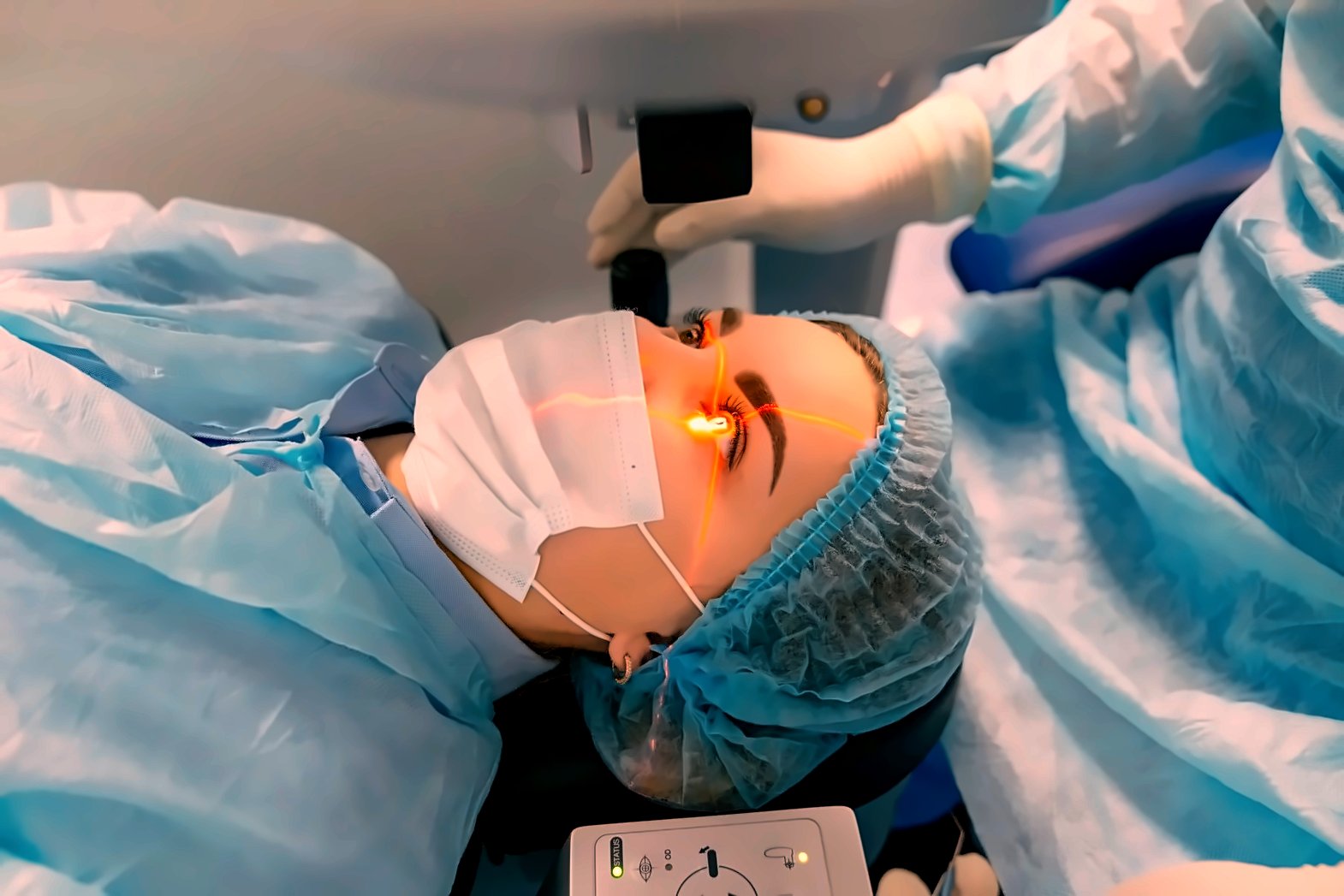
Recovery is similar everywhere: most SMILE and LASIK patients see well within 24–48 hours. You'll need a day-1 check, a check around day 5–7, and then follow-ups at home at one, three and six months.
- China: Usually 5–7 days in the country, with follow-ups included. Hospital-based, so any complication is handled in a full ophthalmology department.
- Korea: Very efficient; some patients fly out on day 4–5. Clinic aftercare is polished, with English-speaking staff on messaging apps.
- Japan: Clinics prefer a week for follow-ups. After you leave, remote support is good in Tokyo and limited elsewhere.
Whichever country you choose, ask for a full copy of your surgical records — pre-op measurements, laser settings and treatment profile. Your eye doctor at home will need them.
Language and Logistics
Korea wins on convenience. Seoul's eye-surgery industry is built around foreign patients, with multilingual coordinators and fast scheduling.
China is strong at the top, uneven elsewhere. Senior surgeons at international departments speak good English, but nursing staff may not. A coordinator who attends appointments with you closes that gap — that's exactly how our process works.
Japan is the hardest without help. Outside a handful of Tokyo clinics, expect to rely on a translator.
On entry, many European and Asian nationalities now enjoy visa-free stays in China, and US citizens can often use the 240-hour visa-free transit. Our China medical visa guide explains your options.
Choose China If...
- You need ICL or have a complex prescription and want a high-volume hospital department with cornea and retina specialists on site.
- You want an all-inclusive package with full pre-op workup and follow-ups bundled.
- You're combining eye surgery with other care — a health checkup, dental work or another procedure — in one trip.
Choose Korea If...
- Convenience is your top priority and you want the smoothest English-language experience.
- You have a short time window and need to be in and out in four or five days.
- You're also considering cosmetic procedures — see our China vs Korea cosmetic surgery comparison.
Choose Japan If...
- You value conservative screening and are happy to pay a bit more for it.
- You already speak some Japanese or will be in Tokyo anyway.
- You'd rather be told "no" than be talked into surgery you don't need.
Frequently Asked Questions
Is SMILE better than LASIK?
Neither is universally better. SMILE uses a small 2–4 mm incision instead of a corneal flap, which means no flap-related risks and often less dry eye — useful for contact sports or very dry eyes. LASIK can treat a wider range of prescriptions, including some hyperopia and complex astigmatism. A good surgeon chooses based on your measurements, not on which machine the clinic owns.
How long do I need to stay in China for LASIK or SMILE?
Plan for 5–7 days. That covers a full pre-op exam on day one, surgery on day two, and checks on day three and around day six or seven. ICL patients sometimes stay a day or two longer because each eye may be done on a separate day.
Can I fly home right after eye surgery?
Flying is safe within 24–48 hours of SMILE or LASIK, but we recommend staying until your day-5-to-7 check. Cabin air is very dry, so bring preservative-free artificial tears and use them often during the flight.
What if I need an enhancement later?
About 1–3% of patients need a touch-up. Reputable hospitals in China include enhancements for one to two years in the package. Confirm this in writing before surgery, and keep your records in case you have the enhancement closer to home.
Want to know which option suits your eyes? Send us your latest prescription and corneal measurements, if you have them, through our free consultation form, or explore our LASIK and vision correction program.
This article is for informational purposes only and does not constitute medical advice. Always consult a qualified healthcare provider for diagnosis and treatment decisions.